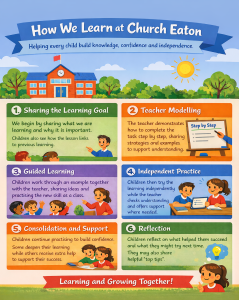
At Church Eaton, our lessons follow a clear structure that helps children understand new ideas, practise their skills and build confidence in their learning. This approach supports all pupils to succeed and ensures learning builds carefully over time.
1. Sharing the Learning Goal
At the start of every lesson, the teacher explains what the children will be learning and why it is important.
Teachers:
-
Make sure pupils understand the learning goal for the lesson.
-
Link the lesson to previous learning so children can see how their knowledge is building.
-
Show how the lesson fits into the bigger learning journey and what the final outcome will be.
This helps pupils understand the purpose of their learning and how each lesson contributes to their progress.
2. Teacher Modelling
Next, the teacher demonstrates how to complete the learning task.
Teachers:
-
Show pupils exactly how to approach the task step by step.
-
Explain strategies that will help them succeed.
-
Use examples, visuals, and clear explanations to support understanding.
-
Highlight common mistakes and how to avoid them.
This stage gives children a clear example before they try the work themselves.
3. Guided Learning
After modelling, the class works through another example together with the teacher’s support.
During this stage:
-
Pupils contribute ideas and help solve the example.
-
The teacher checks understanding and addresses any misunderstandings.
-
Children practise using key vocabulary and sentence starters to explain their thinking.
This allows pupils to practise the new skill with guidance.
4. Independent Practice
Children then have the opportunity to try the task independently.
Teachers use this time to:
-
Check how well pupils have understood the learning.
-
Identify any mistakes or misconceptions.
-
Provide quick feedback to help pupils improve.
Simple tools such as mini whiteboards may be used so teachers can quickly see how everyone is doing.
5. Consolidation and Support
Once the teacher has checked understanding, pupils move on to activities that help secure their learning.
Teachers ensure that activities are accessible for all learners, including pupils with additional needs.
6. Reflection
At the end of the lesson, pupils reflect on their learning. They think about what helped them succeed and what they might do differently next time.
Children may create their own top tip for next time, or the class may agree on one together.
Our goal is for every child to understand what they are learning, practise it with support, and gradually develop the confidence to apply their knowledge independently